I recently spent a couple of weeks teaching at a summer camp in Prato, near Florence. Once the camp had finished, I took the train into Florence and finally visited the renowned Uffizi Gallery.
The experience was quite overwhelming (and the scorching heat certainly did not help). As with the Louvre or the British Museum, there is simply too much to absorb fully in a single visit. Rather than attempting to summarise the whole collection, then, I want to focus on the works that genuinely stayed with me and resonated with my own artistic practice.
I plan to write separately about Caravaggio, whose work has influenced me since my teenage years, so I won’t discuss any of his works on here today. Instead, looking back through my photographs from the Uffizi, I have realised that I had been particularly drawn to two portraits distinguished by their surprisingly arresting gazes.
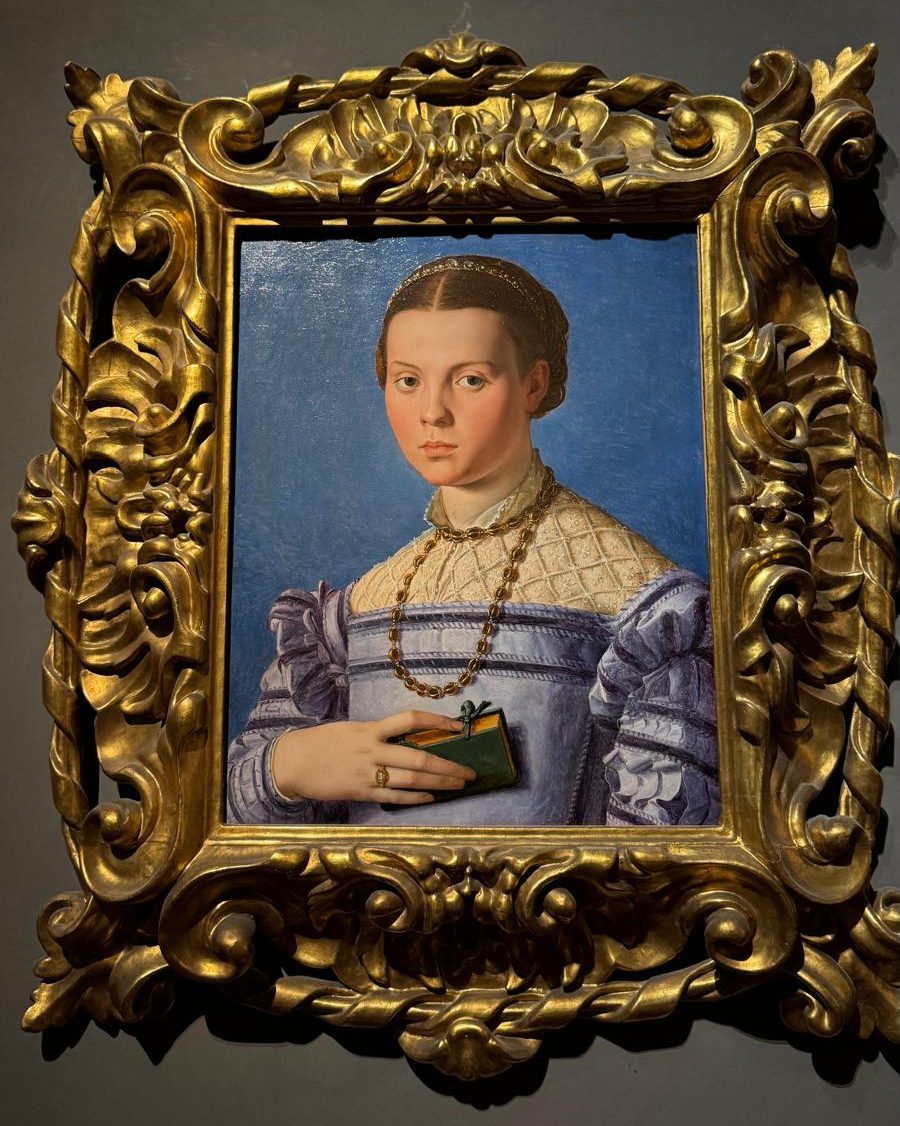
One was Agnolo Bronzino’s Portrait of a Young Lady with a Book. I had never heard of him before, and yet there I was, enthralled by his vivid, almost “juicy” use of colour: the saturated blue, the violet fabric and the pale, strangely controlled surface of the sitter’s face. Yet what held me most was her expression. I had rarely encountered such a tired, distant, almost indifferent gaze in a portrait of a young woman. Such an “inexpressive, reserved, and noncommittal yet arrestingly elegant and decorative”[1] gaze only heightened the tension between that emotional restraint and the intensity of the colour.
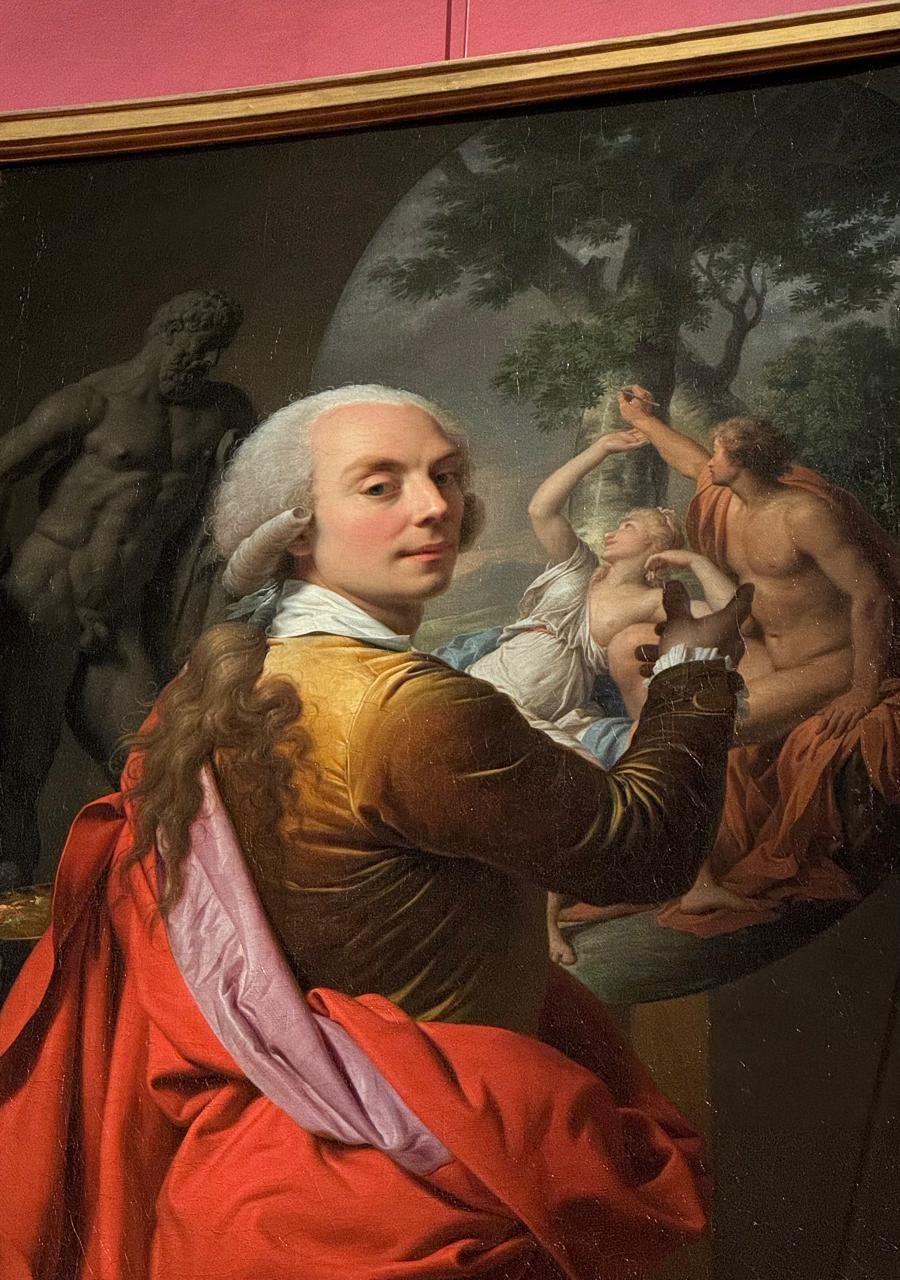
The other work that held me was Giovanni Battista Ortolani Damon’s Self-Portrait from 1789. Perhaps it was partly because I found him particularly handsome, his gaze seemed to pierce through the surface of the painting. Every time I looked at another neighbouring painting, my gaze wandered back to his. His turned body suggests that we have interrupted him at work, yet his expression reverses that relationship: suddenly, it is the viewer who feels observed.
Both portraits felt more intimate, and slightly more uncomfortable to observe (excluding the Caravaggios, of course), than almost anything else I encountered in the gallery. They interrupted my movement through the rooms and, for a moment, looking no longer felt like a one-sided act.
This is something I want to achieve within my own self-portraits. I want the painted gaze to hold the viewer long enough for them to become conscious of their own act of looking. Although the subject is not physically present, the encounter can still feel reciprocal. The viewer looks at the painted figure, but the figure appears to return that attention.
That very moment of discomfort interests me: the point at which observation becomes confrontation, and the person being viewed seems to demand consideration in return.
[1] Il Bronzino | Biography, Paintings, Style, & Facts | Britannica
