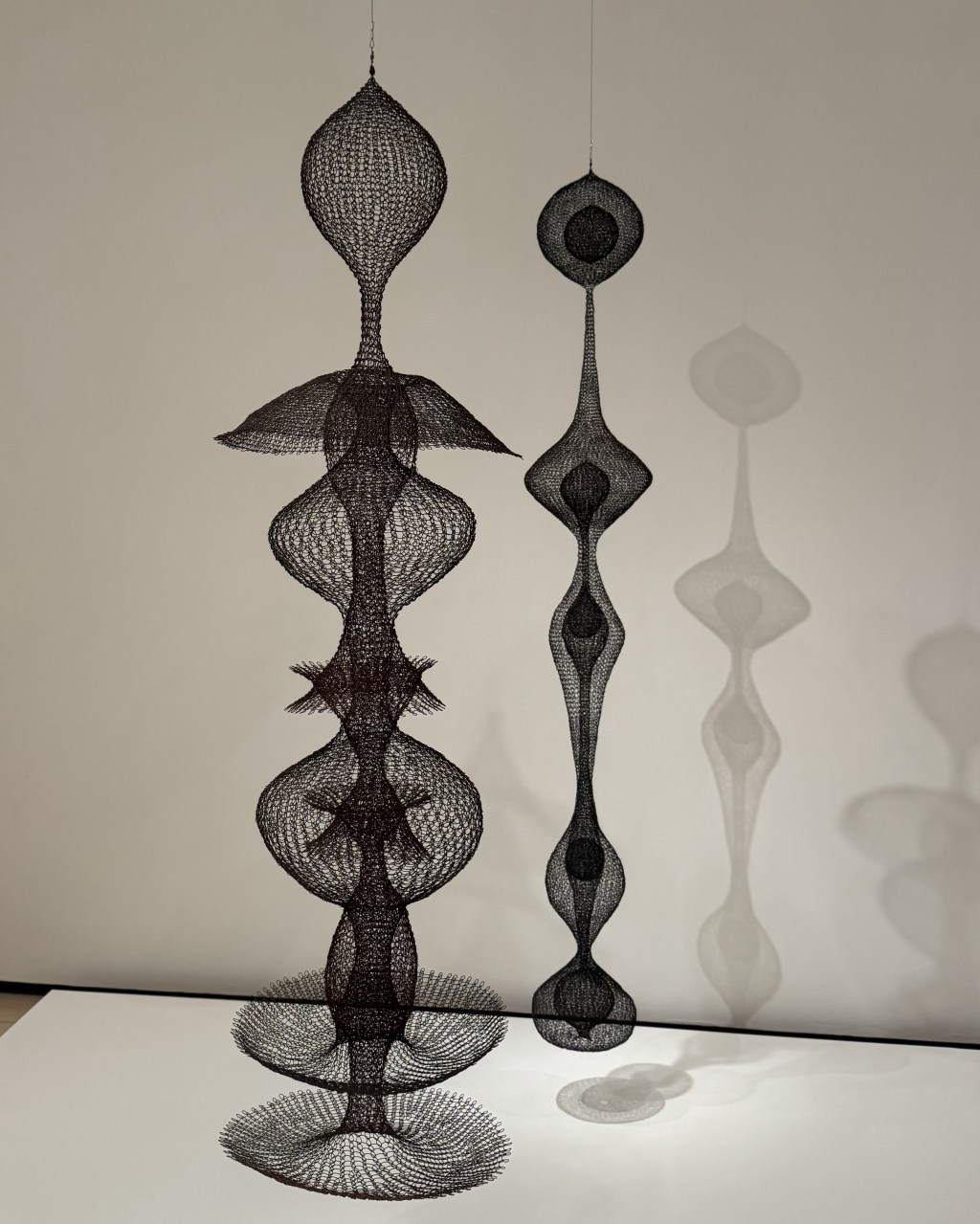
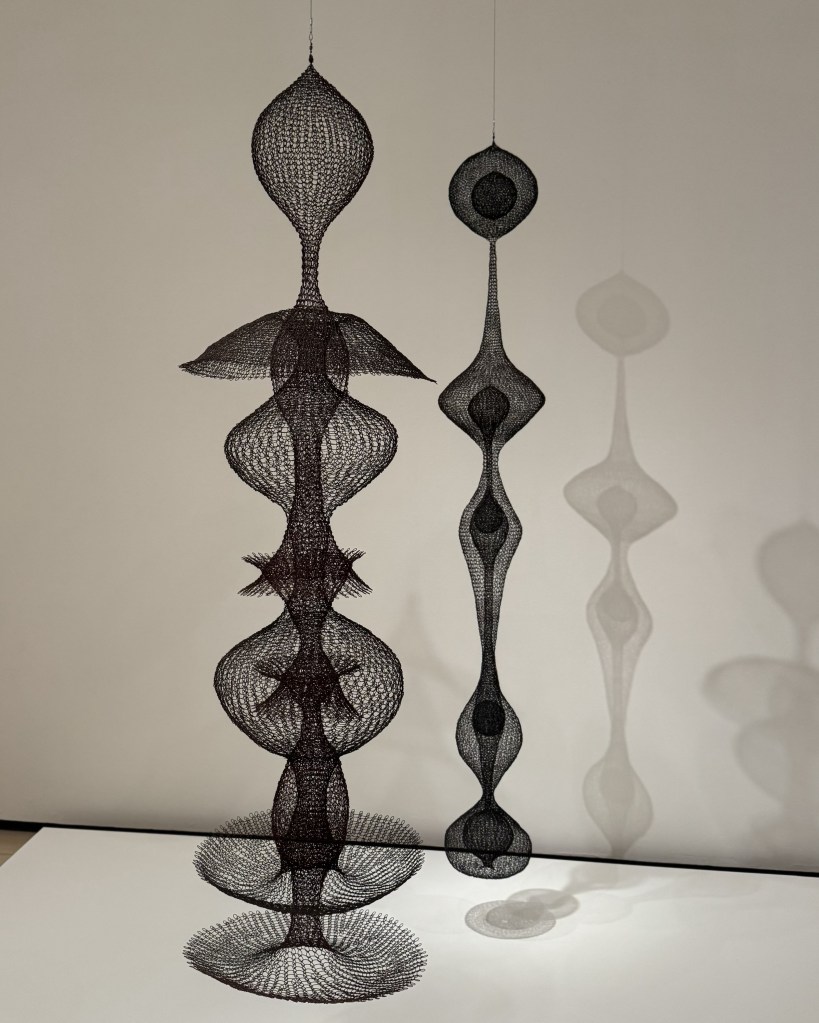
About a month ago I watched a MoMa documentary on the Japanese-American artist Ruth Asawa. It made for the kind of viewing that sits somewhere between learning and relaxation. At the time I enjoyed it, but gave Asawa and her creations no further thought once I had closed my laptop. It was with great surprise, then, that when visiting the Guggenheim Bilbao I saw the name, the wire sculptures, and thought, “Hang on a minute, I’ve seen all this before!”
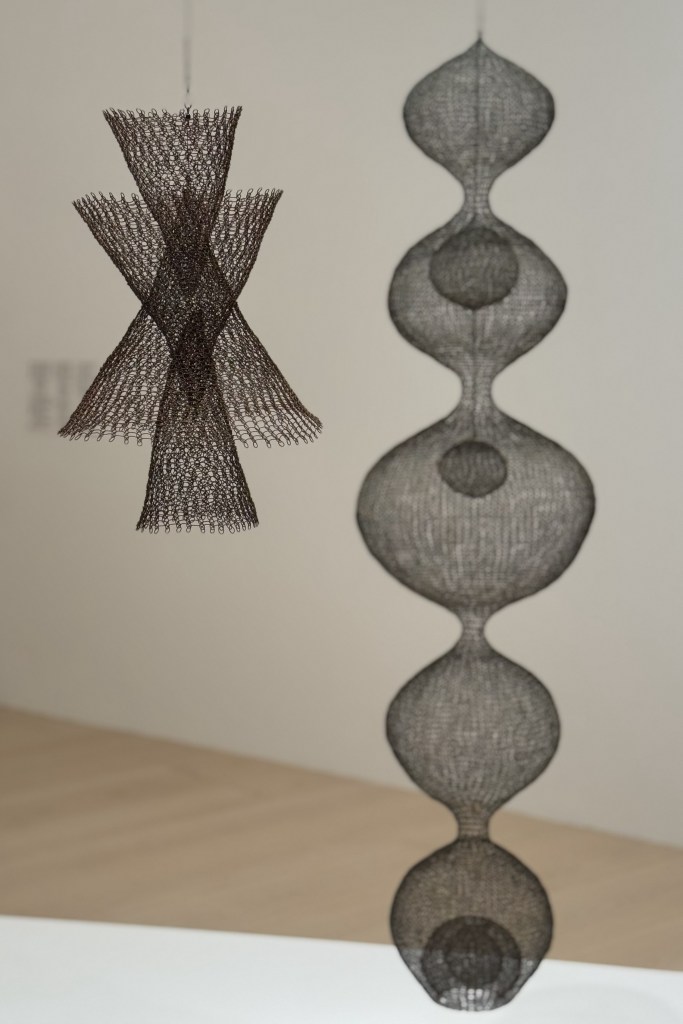
Now, in the metal, I found Asawa’s wire sculptures mesmerising. The skill, the “continuous form within a form”, the seamless looping of the wire that is so rigorous and repetitive while still allowing breathing space – I am in awe of it all. Reflecting on my own work in connection to hers, I keep returning to this idea of layers of the self: all present in one person but existing within us and supporting (or the opposite) us from within, largely unseen. The subconscious, the ego – all of it contained, as in Asawa’s forms, within a single structure that appears whole from the outside.
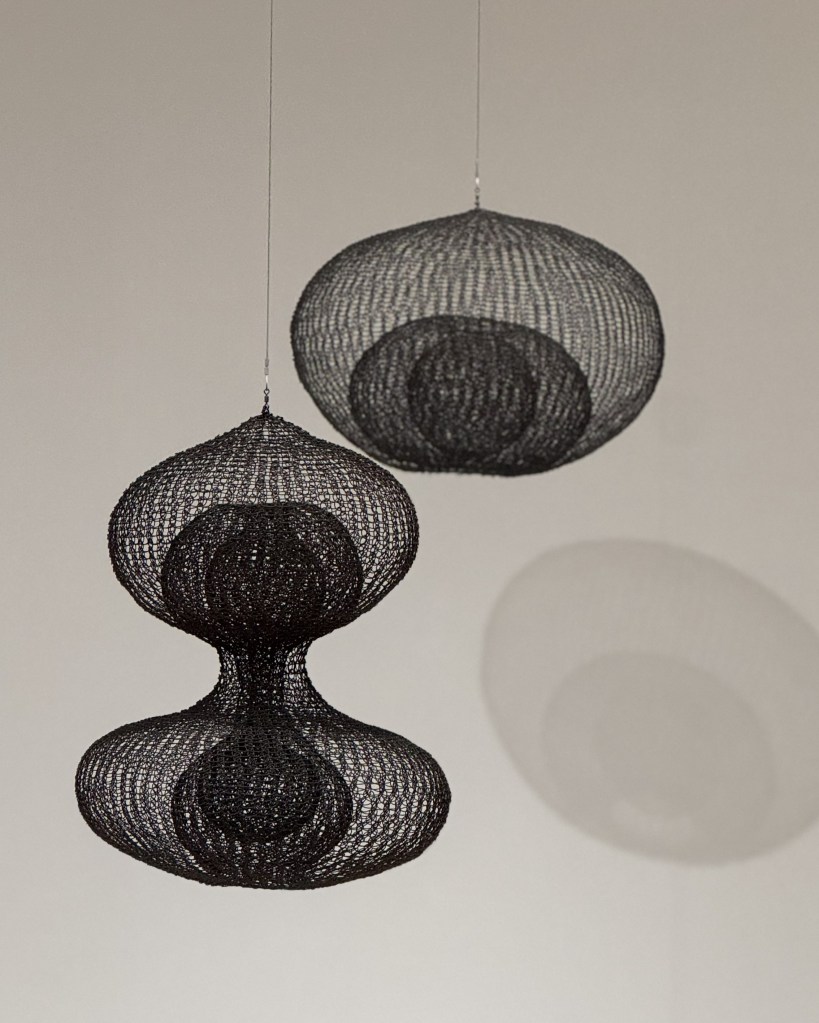
What interests me most in Asawa’s sculptures is not her smooth and rounded spheres but the moments where her wires intersect without softening. Both sections maintain a clearly defined, sharp edge, and yet they are bound together – a roughness that feels almost unwelcome when placed next to the fluid lattice surrounding it. And that is where the parallel becomes most visible for me. Our lives are not shaped in a predictable continuum like Asawa’s more fluid shapes, but are spiked and uneven. No matter how privileged, how sheltered, or how routine one’s life may be or seem, there are always moments of sharp realisation – these unpleasant yet forming experiences that interrupt the continuous flow of the ‘safe before’ and prompt something new.
I think of my own experience as an immigrant, both as a child, and now as an adult. The predictable continuum of routine and familiarity, of a native tongue, abruptly broken by the sudden shift of home and environment. And yet nothing was really broken, the “sculpture” of my life remained linked in one piece. It had sharp edges, but the flow of my presence went on. As Asawa put it, “the relation between outside and inside was independent, integral.”[1] Everything that formed me remains – inside, yes, but affecting my choices, how I present myself, my drive.
I am still alive. All is well.
With time, I think, that forming experience becomes enveloped by the softness of the surrounding sphere – acceptance, adaptation, the initial blow slowly absorbed into something larger. Present, but no longer (or at least, seemingly) disturbing the outer self. Put like this, we may even look at Asawa’s sculptures and treat them as linear journeys parallel to how we experience life itself. Some spheres are empty, some contain more than one formation inside, some have abrupt edges, some almost intercept in the middle. Every experience is unique, and yet all of them involve, as Asawa described it, “a shape that was inside and outside at the same time.” Without the former, there is no latter. Without some kind of internal rupture, there is no external movement.
Asawa herself understood this early, almost ten years before I did. She came to see that “the ideals of social acceptance and job security were a fantasy”[2] – that the only real security was to do what one wanted to do by choice. I have arrived at that realisation later, and less cleanly. Coming to terms with the fact that my own choices had hitherto reflected social expectation more than authentic desire was a recognition sharing much with a rupture. A sharp edge, so to say. One I hope, with time, will be absorbed into something softer.
I left the Guggenheim thinking about transparency, about what it would mean to understand my own parts as layers in the way that Asawa’s sculptures do: integrated, interdependent, with nothing hidden from view.
I don’t think I’m there consistently yet, but I find it refreshing to get a glimpse of my selves every now and then.
